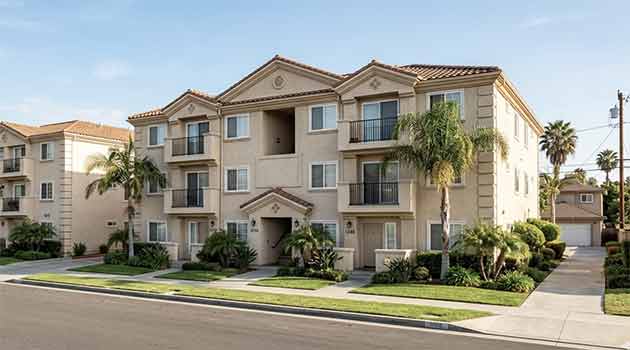
For investors ready to move beyond duplexes but not yet prepared to take on a 50-unit complex
There is a frustrating ceiling most small landlords hit eventually. The duplex cash flows, the triplex is managed, and yet the income feels stagnant while a larger apartment complex seems financially out of reach.
The 8-unit apartment building sits precisely in the middle, large enough to generate meaningful monthly income, and accessible enough to finance without institutional backing. It’s commercially valued in a way that puts appreciation directly in the investor’s control. That gap between small and large multifamily is not as wide as it looks.
Eight Income Streams Under One Roof
Think about what it actually takes to generate $10,000 per month in gross rents from single-family rentals. That likely means five or six separate properties, five or six mortgages, multiple insurance policies, scattered tax parcels, and maintenance spread across different neighborhoods. An 8-unit building replaces all of that chaos with one loan, one insurance policy, one tax bill, and one property address.
In secondary markets such as Knoxville, Boise, or Greenville, a well-located 8-unit property can gross between $9,600 and $14,400 per month at $1,200 to $1,800 per unit. That is real business income, not supplemental cash flow. The operational consolidation alone justifies a serious look at this asset class.
Vacancy at 8 Units Is Not a Financial Emergency
A single vacancy in a duplex wipes out 50% of gross income overnight. The mortgage keeps coming, the holding costs rise, and the pressure to place a tenant quickly often leads to poor screening decisions. One bad tenant in a two-unit building can turn a profitable asset into a liability almost immediately.
In an 8-unit building, one vacant unit represents 12.5% of gross income. The building cash flows through a vacancy, and even two simultaneous vacancies leave six income streams intact. That breathing room allows for patient, thorough tenant screening, which produces better long-term occupancy and a more stable net operating income over time.
“I spent three years buying duplexes and triplexes and honestly felt like I was running in place. The 8-unit I picked up in 2022 generates more cash flow than both of my smaller properties combined, and I spend a fraction of the time managing it.” — Marcus T., residential investor, Columbus, OH
The Unit Mix That Lenders Prefer
Not all 8-unit configurations perform equally, and the unit mix is one of the most consequential decisions in the acquisition process. The strongest-performing buildings tend to hold four one-bedroom units, two two-bedroom units, and one or two three-bedroom units.
Each bedroom count attracts a different renter profile, which naturally diversifies the tenant base against economic shifts that might affect one demographic more than another.
One-bedroom units draw young professionals and recent graduates who prioritize convenience and affordability. Two-bedroom units serve couples and roommates who tend to stay longer because relocation is more disruptive at that life stage. Three-bedroom units pull in established families who represent the most stable tenancy of all.
Lenders take the building’s unit mix seriously too. Bachelor or studio units are routinely penalized in DSCR underwriting due to higher turnover rates and weaker renter stability. A building full of studios can appraise lower and financing is harder than a well-mixed property at the same purchase price.
“We nearly bought an 8-unit with six studio units. Our lender flagged it immediately, the appraisal came in short, and the deal collapsed. The next building we bought had a proper mix of one’s and two-bedrooms, and the financing was night and day.” — Priya S., multifamily investor, Phoenix, AZ
Income-Based Valuation Helps Appreciation
Properties of one to four units are appraised through the sales comparison approach, meaning an appraiser looks at what similar nearby properties sold for recently. Investors have almost no direct influence over that number. If the local market is soft or comparable sales are scarce, value stagnates regardless of how well the property performs.
Eight-unit buildings are evaluated on net operating income (NOI) and local capitalization rates. NOI divided by the cap rate determines value. Since the investor controls income and expenses, appreciation becomes a matter of financial management rather than luck. If you raise rents $100 per unit in a 6% cap rate market and the building gains roughly $160,000 in appraised value. No renovation. No waiting on comparable sales to catch up.
Value-Add Strategies That Produce Returns
Below-market rents are the most common and often the most lucrative opportunity in the 8-unit space. Many of these buildings are still owned by original landlords who have raised rents conservatively or not at all. A property running 15% below market rents on a 12 or 24-month increase schedule can materially reposition NOI without a dollar spent on construction.
Beyond rent increases, app-based laundry systems can replace outdated coin-operated equipment at near-zero landlord cost. Covered or assigned parking in supply-constrained markets can add $50 to $125 per space monthly. Interior upgrades such as LVP flooring, modern fixtures, and updated cabinet hardware are best deployed on vacant units to justify top-of-market rents and demonstrate market rent income to future appraisers.
Utility Setup Varies by Market
Most 8-unit buildings are individually metered which means each tenant pays their utility provider directly with no landlord involvement. The exception is older urban buildings, particularly pre-1970s buildings in New York City and Chicago, where master-metered configurations remain common. New York State’s energy agency NYSERDA even operates a dedicated submetering incentive program because the issue is so widespread there (nyserda.ny.gov/All-Programs/Multifamily-Building-Programs/Submetering).
California small multifamily properties of 5 units or more are predominantly individually metered, especially those built after 1982, per Southern California Edison’s rate guidelines (sce.com/save-money/rates-financing/multifamily-rates-billing).
The investor’s job is to confirm the metering setup during due diligence. In a master-metered building, RUBS may be an option worth evaluating to recover utility costs that are listed on the expenses. In an individually metered building, that question is already answered. Either way, it is an important item on the due diligence checklist, not a reason to walk away from an otherwise sound deal.
DSCR Financing Is Built for This Asset Class
Five-plus unit properties move out of residential lending guidelines and into commercial underwriting, where the property’s own income drives qualification. DSCR loan programs are built precisely for income-producing assets at this scale.
Investors with complex tax situations, multiple entities, or self-employment income often qualify more cleanly under DSCR standards than they would through conventional residential channels.
An 8-unit building at market rents typically generates enough gross income to satisfy DSCR thresholds comfortably, which is a key reason this asset class performs well under that program. See our DSCR loan program page for full qualification details, rate structures, and lender requirements.
“My CPA writes off everything legally, so on paper my income is minimal. The DSCR product was the first time the property had to qualify instead of me. It changed everything.” — David L., portfolio investor, Denver, CO
Exit Options Are Broader Than Most Investors Expect
When the time comes to sell, 8-unit properties attract a genuinely wide buyer pool. Individual investors, first-time commercial buyers, small syndicators, and local operators all compete for well-located buildings at this unit count. That demand depth tends to produce stronger pricing and shorter marketing timelines than larger commercial properties, where the buyer pool narrows to institutional or semi-institutional capital.
Investors deferring capital gains taxes will find 8-unit buildings are practical 1031 exchange candidates on both ends of a transaction. They are accessible enough to serve as replacement properties when selling smaller assets, and substantial enough as the relinquished property when stepping into 20 or 30-unit deals. Some markets also support condo conversion as an exit path, where selling units individually yields per-door values well above the building’s income-based appraisal.
“I bought an 8-unit in Cleveland for $680,000, forced about $90,000 in appreciation through rent increases over three years, then used the 1031 to roll into a 24-unit. The 8-unit taught me how the game actually works.” — Angela R., commercial real estate investor, Cleveland, OH
The Case for Making This Move Before You Feel Fully Ready
The 8-unit apartment building is not a consolation prize for investors who cannot yet afford something larger. It is a calculated step that delivers real income, commercial-grade valuation upside, and access to a lending ecosystem that simply does not exist at the duplex or triplex level.
The due diligence process, which includes reviewing rent rolls, trailing P&L statements, expense ratios, and lease structures, builds exactly the analytical skills needed for 20 and 50-unit acquisitions later.
Most investors who make this move say the same thing afterward: they wish they had done it sooner. The gap between small residential investing and true commercial multifamily has always felt wider than it actually is. An 8-unit building is where that gap closes.
Ready to explore DSCR financing for an 8-unit acquisition? See our DSCR loan program page for full program details.