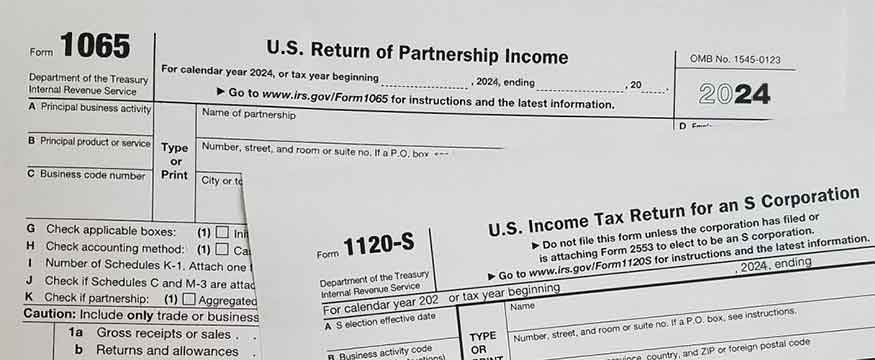
Traditional mortgage underwriting rarely works in your favor if most of your income flows through K-1s (Form 1065 or 1120S). That’s especially true when your tax returns reflect passive losses or aggressive write-offs.
Lenders often overlook actual cash flow and fixate on adjusted gross income, even when your year-to-year distributions tell a better story.
That’s where this new K-1 income-only loan comes in. You don’t need to hand over full tax returns, bank statements, or W-2s. Just your Schedule K-1s.
It’s streamlined for business owners and partners who have real income but don’t always show it the traditional way.
K-1s Are Common Among High-Income Professionals
You’re not alone if you’re paid through a K-1. In fact, a growing number of high-earning individuals are in this exact position. You might be one of them if your income comes from:
| Professions Likely to Receive K-1 Income | Examples |
| Medical & Legal Partners | Physicians in group practices, law firm equity partners |
| Consulting, Investment, and Financial | Management consultants, investment bankers, accounting firm partners |
| Real Estate & Development | Syndicators, brokers in partnerships, developers |
| Business Owners | S-Corp shareholders, LLC members, private company owners |
| Energy & Trust Beneficiaries | Oil and gas interest holders, estate or trust beneficiaries |
These professionals often receive substantial distributions through ownership in a pass-through entity. Unfortunately, most conventional underwriters don’t interpret K-1s properly. This primarily occurs when losses offset income or when you retain earnings inside the business.
What Prevents K-1 Earners from Getting Approved
Even if you’ve had a strong year, you might get turned down. Here’s why that happens more often than it should:
- Your business reinvested profits, so your net income looks low.
- You took legitimate deductions that lower your taxable income.
- Passive income isn’t viewed the same as active income by lenders.
- You don’t show consistent W-2 wages from your business.
If you own at least 25% of the company, most lenders will want to review two full years of tax returns, not just your K-1s but also the business returns. That means deeper scrutiny and less control over the narrative.
This Loan Uses K-1 Income Only. No Full Tax Returns Needed
This new loan program treats K-1 income as the only qualifying factor. That’s a significant shift from the standard process.
You submit your last two years of K-1s, and the lender uses only what’s reported there. There’s no need to explain deductions or justify your tax strategy. The program focuses on:
- Net income allocations on Line 1, Line 4, or Line 14
- Consistency of distributions across 12–24 months
- Ownership percentage within the business or investment structure
- No need for full personal or business tax returns
If you’re an equity partner in a law firm, a physician in a group practice, or a stakeholder in a syndication, this can finally level the playing field. Your true income gets recognized without being filtered through tax code gymnastics.
Not All K-1s Are Created Equal
How much of your K-1 income counts toward your mortgage approval depends on more than just the total figure at the bottom. While it’s easy to assume all of it will be used, lenders pay close attention to what’s on Schedule K-1 (Form 1065 or 1120S) and where the income is coming from.
If you’re not familiar with which line means what, you’re not alone. Most borrowers don’t analyze their own tax documents. In many cases, even high-income partners and business owners rely on their CPA or tax advisor to interpret the numbers. That’s completely normal.
But when it comes to qualifying for a mortgage using K-1 income only, understanding a few key lines can make a big difference.
What Lenders Focus On:
- Line 1 (Ordinary Business Income): This is typically the most relied-upon figure when calculating usable income from partnerships or S-Corporations.
- Line 4 (Interest Income): May be included if it’s recurring and linked to business operations or investment activity.
- Line 14 (Self-Employment Earnings): Particularly relevant when determining Social Security and Medicare tax implications, and sometimes used in income analysis for sole proprietors or general partners.
- Distributions vs. Allocations: Lenders will look for consistency. Regular distributions over the past one to two years strengthen your overall profile.
Some income on a K-1 is passive or non-cash, and lenders are cautious about counting amounts that don’t reflect real inflows. If you’re a limited partner receiving income sporadically or from a volatile industry, you may be asked to provide additional context or historical data.
If you’re unsure how your K-1s are structured, your CPA should be your first stop. A good loan advisor can also work directly with them to identify what’s eligible and what might raise flags with underwriters. A pattern of consistent annual earnings across multiple entities improves approval odds.
Let’s Compare K-1, P&L, and Asset-Based Loans
You may wonder how this stacks up against the other two well-known non-QM options: P&L Loans and Asset Depletion Loans. Here’s a side-by-side breakdown:
| Feature | K-1 Income Loan | P&L Loan | Asset Depletion Loan |
| Income Verified By | Schedule K-1 | Profit & Loss Statement (CPA or CTEC) | Personal Liquid Assets |
| Tax Returns Required? | No | No | No |
| Ideal Borrower | Equity partners, investors, S-Corp owners | Business owners with recent growth | Retirees, investors, HNW individuals |
| Common Pitfall | Irregular distributions | Needs CPA involvement | Requires high liquidity |
| Credit Score Minimum | 660–700+ | 660+ | 680+ |
| Down Payment | 15–25% | 10–20% | 10–15% |
Each program caters to a different scenario. K-1 loans work best when you receive regular profit distributions. If your business is cash-heavy but not yet profitable, a P&L loan might fit better. If you’re living off investments or liquid assets, asset depletion may offer lower rates with fewer moving parts.
Some Borrowers Are Better Off Using Liquid Assets
Suppose you have over $1.5 million in non-retirement brokerage accounts, or $1 million in cash reserves. Even if your K-1 income is erratic or non-existent, an asset-based mortgage loan might be the easier and cheaper option.
The lender applies a formula to your liquid net worth often dividing the total by 84 months to arrive at monthly “income.” There’s no employment check or income documentation needed.
When Asset-Based Loans Win:
- You sold a business and are now investing
- You retired early with no earned income
- You’re sitting on significant capital from a liquidity event
In those cases, the asset depletion route could offer simpler paperwork and better interest rates, especially for larger loans.
What You Need to Qualify Using K1’s
Lenders who offer this program are still cautious about risk. You’ll need a few essentials to get started:
- Two years of complete K-1s from all entities
- Credit score above 660 (higher scores improve pricing)
- Proof of continued ownership in each business
- Mortgage history showing no late payments
- Asset documentation for reserves (often 6–12 months of PITI)
Some lenders also request an ownership letter or operating agreement, but not full tax returns or bank statements.
Example: Real Estate Developer with $400K in K-1 Income
Sam is a managing partner in a Denver-based multifamily development firm. He earns a modest W-2 of $90,000 but receives over $400,000 annually on K-1s. Most of that income is reinvested in future projects.
He was denied a conventional loan because his AGI showed just $150,000 after depreciation and carryover losses. Using the new K-1 loan, his income was calculated based only on Line 1 across two years, totaling $820,000. He closed on a $2.2 million home with 20% down.
Questions Borrowers Ask Most
- Can I use multiple K-1s from different businesses? Yes, income can be aggregated if each K-1 meets ownership and income standards.
- Do I need to show liquidity? Most lenders want to see reserves equal to 6–12 months of housing expenses.
- Will my losses hurt me? Not if the current year’s K-1s show gains and ongoing profitability.
- Can I use this for an investment property? Yes, this program works for primary, second home, or rental purchases.
Final Thoughts
This new mortgage program removes many of the hurdles you’ve likely faced as a business owner or passive investor. K-1 income no longer needs to be explained or backed up by piles of tax returns. If you consistently earn money from your partnerships, practices, or investments, your income should speak for itself.
Whether you’re earning through real estate syndications, medical group profits, or professional consulting partnerships, this could be the most streamlined and practical option to finance your next home.